


Is it really possible to use a heat pump in an older house?
Discover how upgrading your home’s insulation can lead to significant energy savings and open up the possibility of using a more, efficient heating system.
Enhanced Comfort
Experience a warmer less drafty home and see reduced energy bills with improved your insulation levels
Eco-Friendly Solutions
By thermally improving your home, you may be able to install a highly energy efficient heat pump

The Role of Insulation
Why Insulation Matters
In this blog post we are going to look at the difference improved insulation can make to the amount of heat your home requires.
Enhanced insulation in a home significantly reduces heat loss, allowing for a smaller Heat source (boiler or heat pump) to be installed. This is because the improved thermal barrier retains warmth more efficiently, requiring less energy to maintain a comfortable indoor temperature.
We are going to show this by thermally modelling a generic 1950’s detached house from when it was built through various improvements that may have been made or could be made to the building
It should be noted that the heat loss models prepared in this exercise comply with BSEN12831 because this is the standard that is generally required for sizing heating systems in domestic dwellings, such as heat pumps and also the standard required for government grants such as the Boiler Upgrade Scheme. This is a fairly simplistic model as it does not account for building orientation, solar gains (heat through windows) or internal gains (heat provided by activities such as cooking and heat from humans and animals within the building)
It should also be noted that all houses are different and the insulation measures we look at in these examples may or may not be suitable for your property.
Only when you know the heat losses of your home , can you look at ways of improving it. If you would like is to model your home, please get in touch.
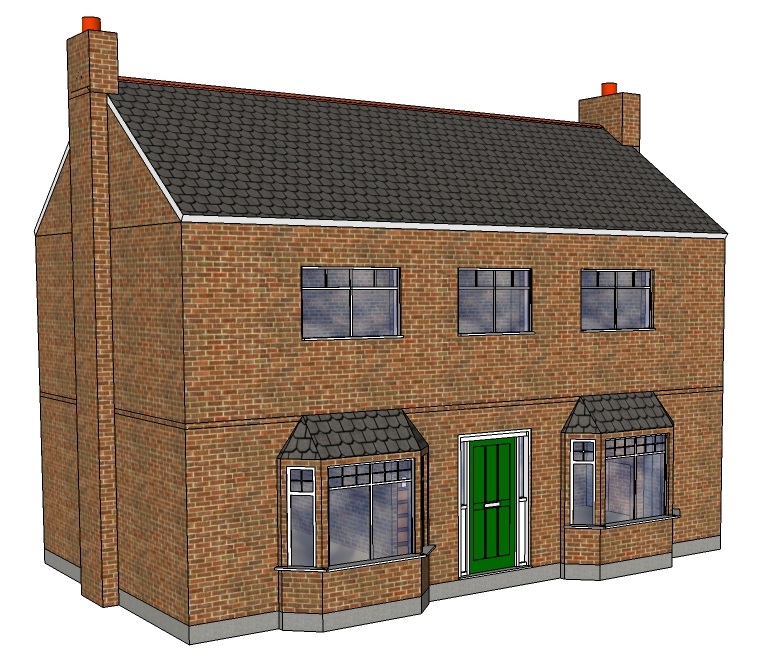
A house of the 1950's
Our example house is a fairly typical mid 20C detached house, it’s 3 bedroomed with approximately 100m2 internal floor space, located in the midlands.
Construction wise, it had :-
- A suspended ground floor
- brick cavity walls
- a pitched roof
- single glazing
- Solid wood doors
- No insulation was used. Loft insulation in the UK wasn’t mandated until the late 1960’s .
- Open fires
U-Values
What is a U-value
If you are looking to improve the thermal efficiency of your home, you will often come across a phrase U-value.
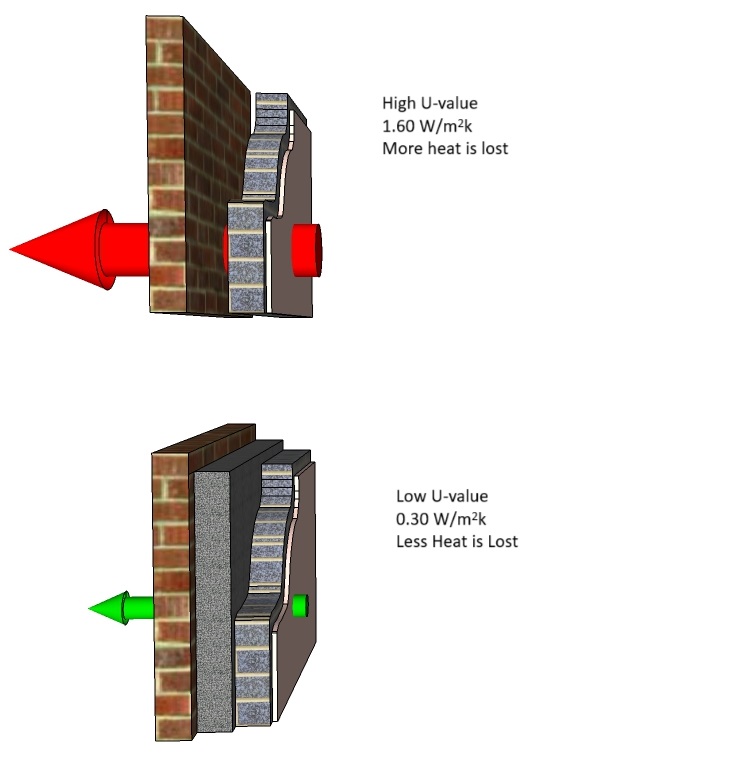
A U-value is simply a measure of thermal transmission, in other words how much heat (measured in watts) moves from the warm side of an element to the cold side per difference in degrees kelvin between the warm and cold faces, for a given square meter of material surface area
It is expressed as W/m2k.
The lower the number, the more insulating a material is. For example a single glazed window will typically have a u-value of 4.8 Wm2k, whereas a triple glazed widow will typically have a u-value of 1.0 w/m2k, meaning almost five times as much heat would be lost through a single glazed window compared with a triple glazed window of the same size
Example of how insulation lowers U-value and reduces heat loss
1950's House Heat Loss as built
Ver 1 Heat Losses when there is no insulation
When this house was built no insulation was used, so for this model we will be using the following u-values:-
• 1.20 W/m2k Suspended ground floor
• 1.60 W/m2k External Brick cavity walls
• 2.30 W/m2k Pitched roof no insulation
• 4.80 W/m2k Single glazed windows
• 3.00 W/m2k Solid wood doors
The house was not very air tight and so we have assumed air tightness would be around 15m3/hr:m2 at 50 pascals and because there were open fires in the lounge and dining room, air changes rates for those rooms is likely to have been 6.5 air changes per hour.
So it comes as no great suprise that the heat losses for this version are very high.
Results of heat loss v1 - with no insulation
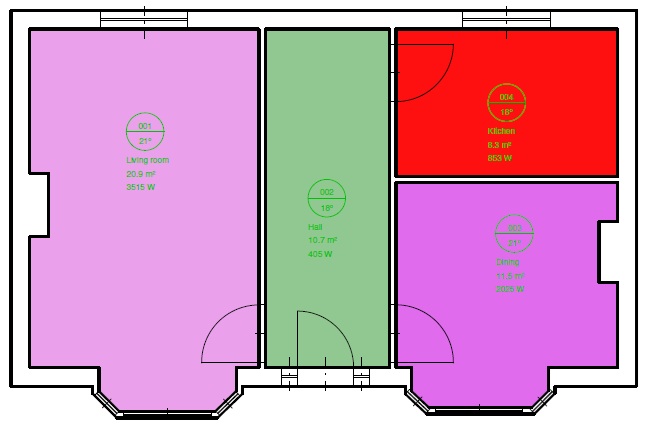
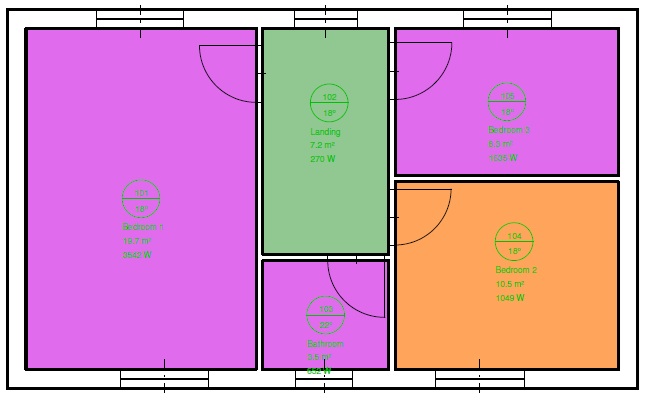
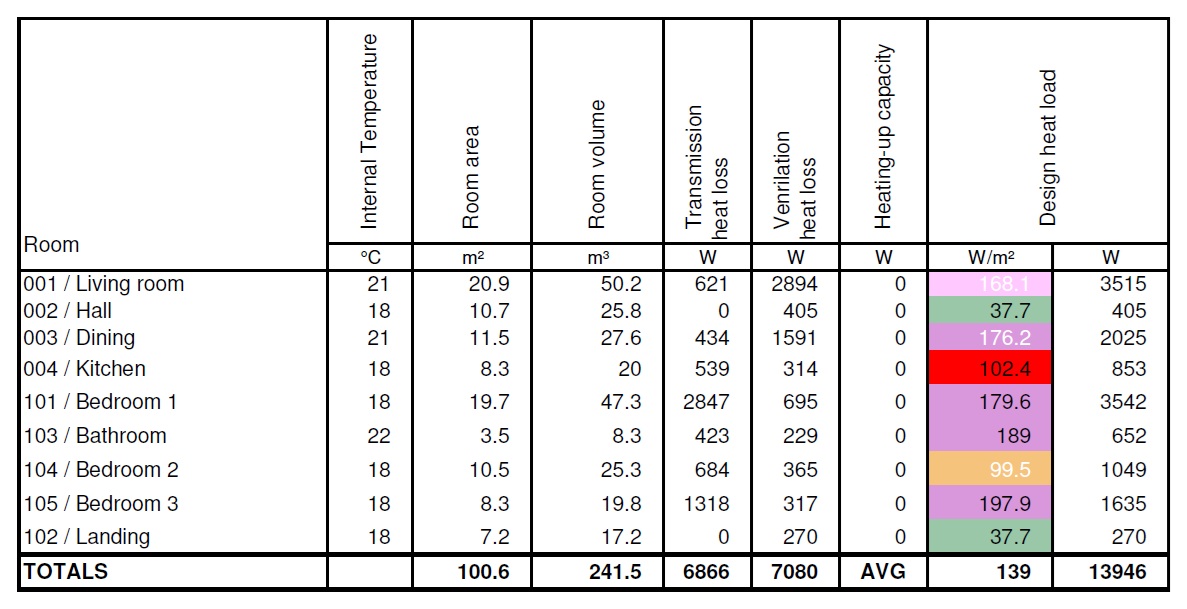
Clearly this model is quite extreme but is representative of the few remaining buildings of this type.
Lets drill down in to the data
There are five rooms (shown in pink) which stand out as being exceptionally cold:-
Both the living room and dining room have open fires, so any heat in the room has an unimpeded escape route, straight up the chimney, this alone increases the air change rate by 5 air changes per hour.
The first floor rooms have a simple lath and plaster ceiling adjacent to the unheated and uninsulated lost space. Additionally the bathroom is designed to be warmer than the adjacent rooms and so it will transmit heat to them.
Interestingly, you will note that both the hall and landing have relatively low heat losses. This is primarily because they are adjacent to warmer rooms, which allows heat to transfer into the hall and landing.
Without any insulation and with two open fires the heat load for this building is almost 14 kW
1950's House Heat Loss after limited improvements
Ver 2 Heat Losses with limited improvements
Following the advent of smokeless zones in the UK, much of the housing stock with open fires had these decommissioned.
By the 1970’s on the back of the global energy crisis, the UK government insentivised the installation of loft insulation.
In this example we have assumed
1) That our house no longer has open fires.
2) That our house has 50mm mineral wool insulation installed in the loft
No other changes were made
So for this model we will be using the following u-values:-
• 1.20 W/m2k Suspended ground floor
• 1.60 W/m2k External Brick cavity walls
• 0.68 W/m2k Pitched roof with 50mm inulation
• 4.80 W/m2k Single glazed windows
• 3.00 W/m2k Solid wood doors
The house was not very air tight and so we have assumed air tightness would be around 15m3/hr:m2 at 50 pascals
and because there are no longer any open fires in the lounge and dining room, air changes rates for those rooms is likely to have been reduced to 1.5 air changes per hour.
Even with these limited improvements the resulting reduction in the building heat loss not insignificant.
Results of heat loss v2 - with limited insulation
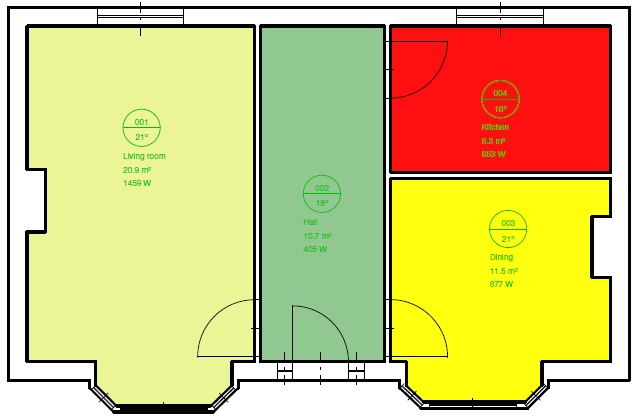
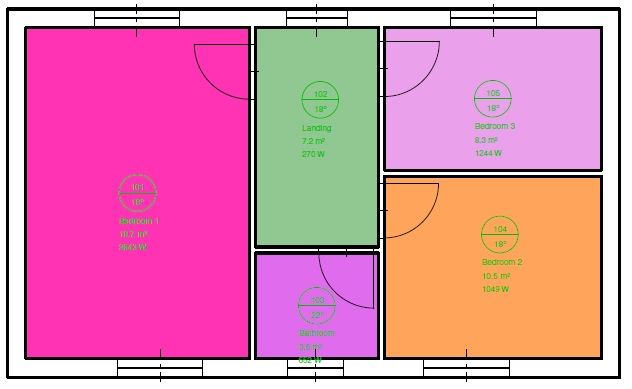
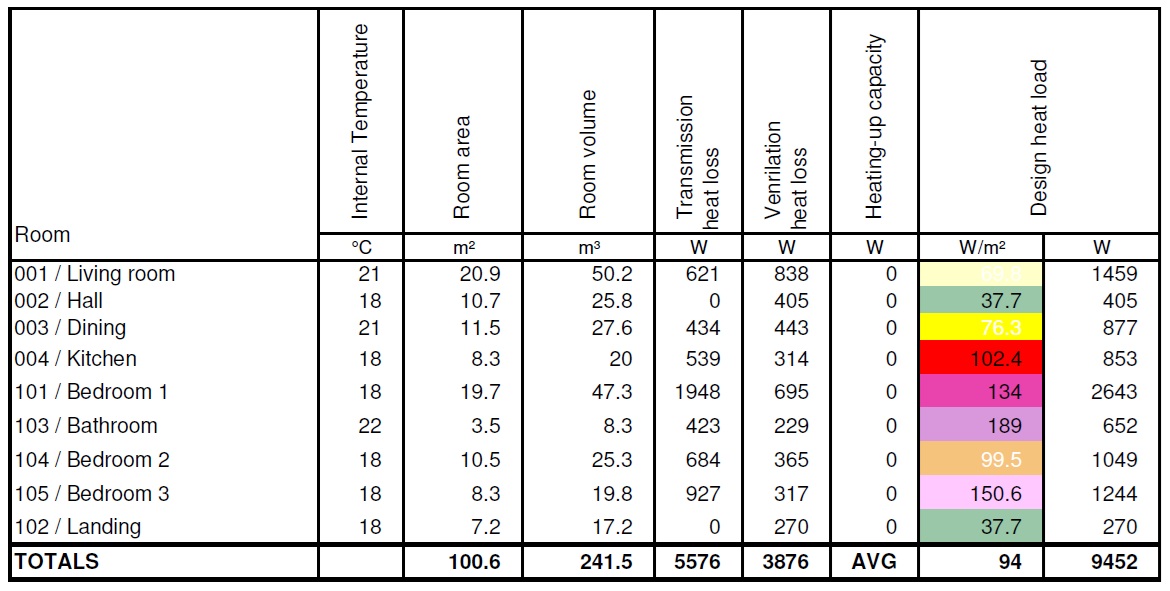
Dwellings with such limited insulation are quite rare but this model is is representative of the few remaining buildings of this type.
Lets drill down in to the data
So immediately visible are the reduced heat losses to both the living room and dining room due to removal of the open fires.
And whilst the level of loft insulation is significantly less than current standards, there is still a reduction to the heat losses of all first floor rooms.
The result of these simple improvements is a reduction of over 32% in the total heat load when compared with the original house
With no open fires and the introduction of very limited insulation the heat load for this building has reduced to 9.5 kW
1950's House Heat Loss with Limited Old Double Glazing and limited insulation improvements
Ver 3 Heat Losses with typical 1980's improvements
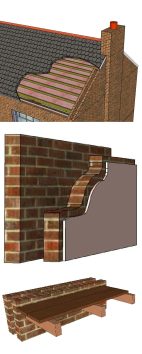
By the 1980’s double glazing became much more deployed in the UK
In this example we have assumed
1) That our house no longer has open fires.
2) That our house has 50mm mineral wool insulation installed in the loft
3) Double glazing was installed to the entire property
No other changes were made
So for this model we will be using the following u-values:-
• 1.20 W/m2k Suspended ground floor
• 1.60 W/m2k External Brick cavity walls
• 0.68 W/m2k Pitched roof with 50mm inulation
• 2.80 W/m2k Double glazed windows
• 2.80 W/m2k Double wood doors
The house is now a little more air tight and so we have assumed air tightness would be around 10m3/hr:m2 at 50 pascals
With these improvements the resulting reduction in the building heat loss reduces further
Results of heat loss v3 - with limited insulation and older double glazing
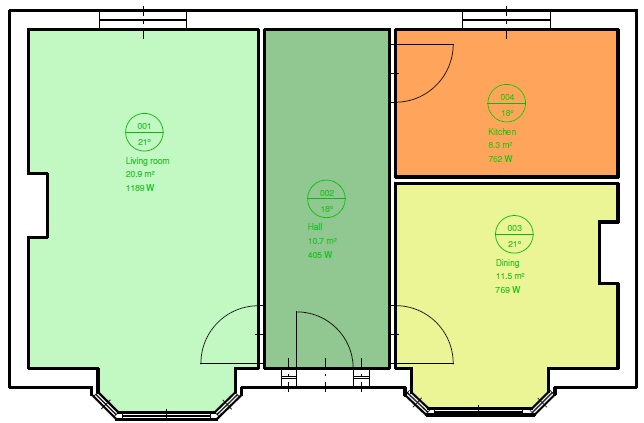
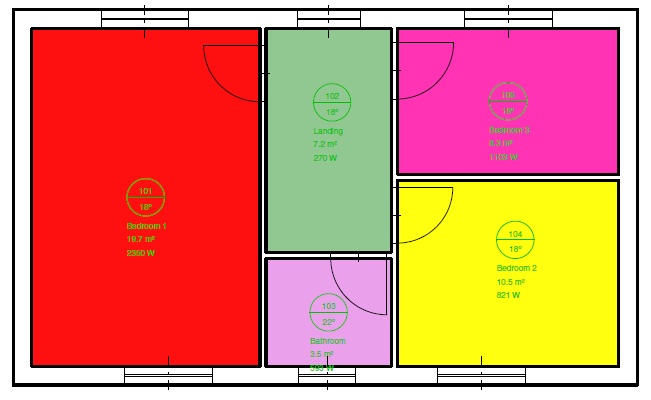
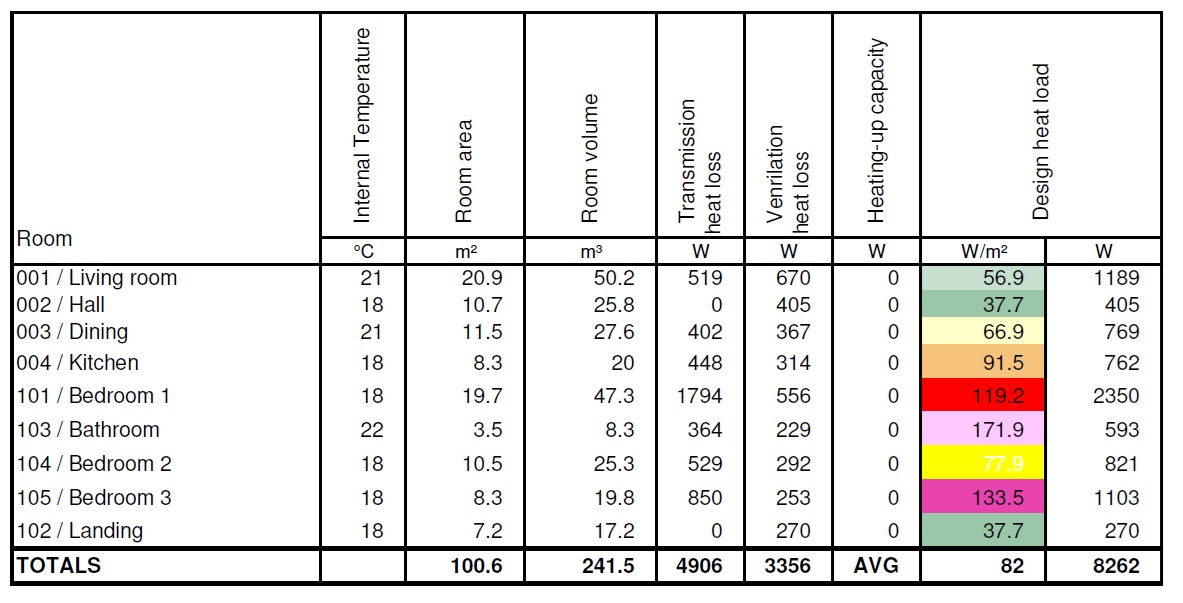
This model is rather typical of older housing stock that have been in the same ownership for a number of years and have recently come onto the market requiring updating
Lets drill down in to the data
So immediately visible are the ground floor rooms, which are now showing fairly reasonable heat losses mainly due to the installation of double glazing (and remember new double glazing units perform significantly better than the 1980’s units we have used in this model.
First floor rooms have improved a bit but are still showing fairly high heat losses, (this is because we have still assumed low levels of loft insulation)
The result of these simple improvements is a reduction of around 13% in the total heat load compared with version 2 and over 40% reduction compared with version 1
With the introduction of very limited insulation and older double glazing the heat load for this building has reduced to 8.3 kW
1950's House Heat Loss with typical insulation improvements
Ver 4 Heat Losses with typical 1990's improvements
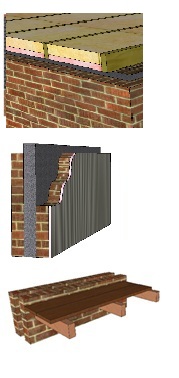
By the 1990’s there was a drive to improve the insulation in older houses, this included enhanced loft insulation and retro installed cavity wall insulation
In this example we have assumed
1) That our house no longer has open fires.
2) That our house has 150mm mineral wool insulation installed in the loft
3) Double glazing was installed to the entire property
4) Cavity wall insulation has been installed
No other changes were made
So for this model we will be using the following u-values:-
• 1.20 W/m2k Suspended ground floor
• 0.70 W/m2k External Brick cavity walls
• 0.35 W/m2k Pitched roof with 150mm inulation
• 2.80 W/m2k Double glazed windows
• 2.80 W/m2k Double wood doors
The house is now a little more air tight and so we have assumed air tightness would be around 10m3/hr:m2 at 50 pascals
With these improvements the resulting reduction in the building heat loss reduces further
Results of heat loss v4 - with cavity wall insulation
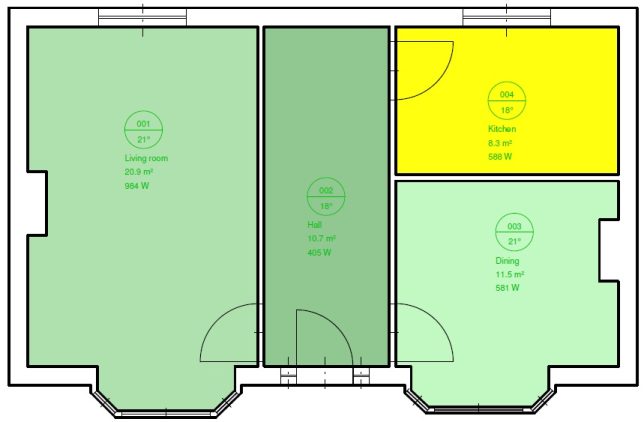
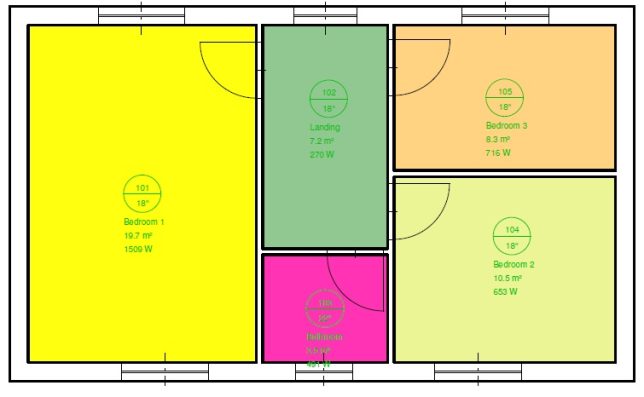
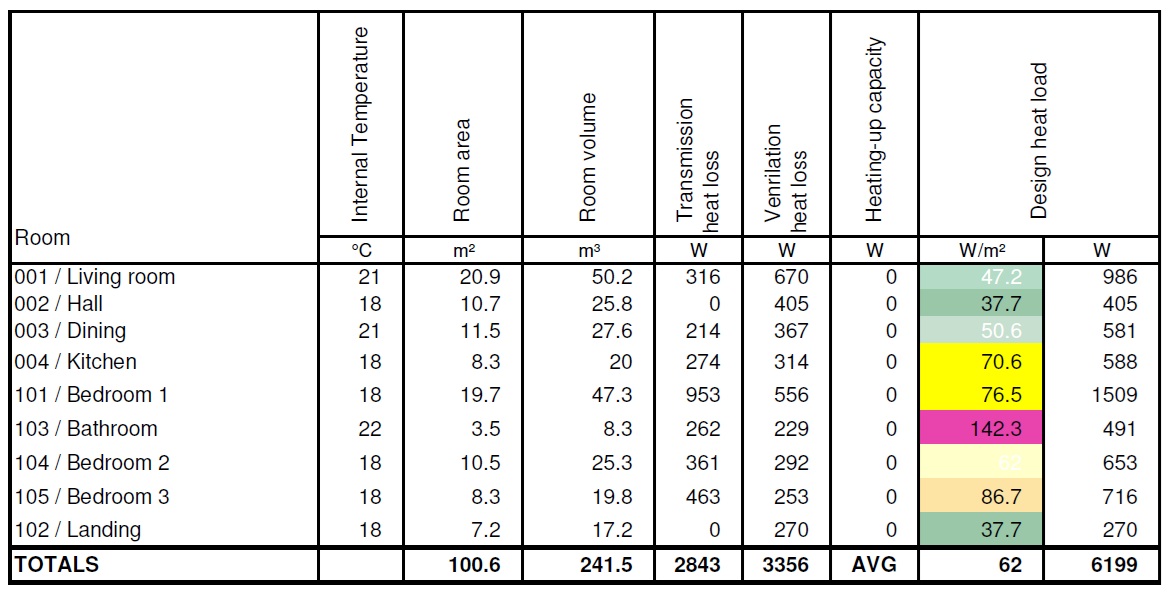
This model is rather typical of older housing stock that have been in the same ownership for a number of years and have recently come onto the market requiring updating
Lets drill down in to the data
So immediately visible are the ground floor rooms, which are now showing fairly reasonable heat losses mainly due to the installation of double glazing (and remember new double glazing units perform significantly better than the 1980’s units we have used in this model.
First floor rooms have improved a bit but are still showing fairly high heat losses, (this is because we have still assumed low levels of loft insulation)
The result of these simple improvements is a reduction of around 25% in the total heat load compared with version 3 and over 56% reduction compared with version 1
With the introduction of fairly limited insulation and older double glazing the heat load for this building has reduced to 6.2 kW
1950's House Heat Loss with modern insulation improvements
Ver 5 Heat Losses with post 2021 improvements
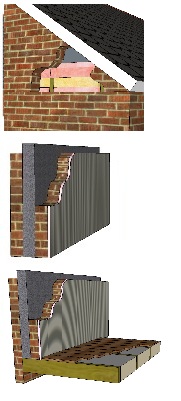
Let’s assume that our house is now in new ownership and the current owner wants to improve the house to modern standards
In this example we have assumed
1) That our house no longer has open fires.
2) That our house has 300 mm mineral wool insulation installed in the loft
3) New double glazing was installed to the entire property
4) Cavity wall insulation has been installed
5) the suspended floor has been insulated with 150mm PIR insulation (this may not be practical in all old houses)
6) The house has been air pressure tested and air leakage has been reduced to 5m3/hour, which also reduces the individual room air change rates
No other changes were made
So for this model we will be using the following u-values:-
• 0.18 W/m2k Suspended ground floor with 150mm PIR insulation
• 0.70 W/m2k External Brick cavity walls
• 0.13 W/m2k Pitched roof with 300mm inulation
• 1.40 W/m2k Double glazed windows
• 1.00 W/m2k Upgraded external doors
With these improvements the resulting reduction in the building heat loss reduces further
Results of heat loss v5 - improved to current standards
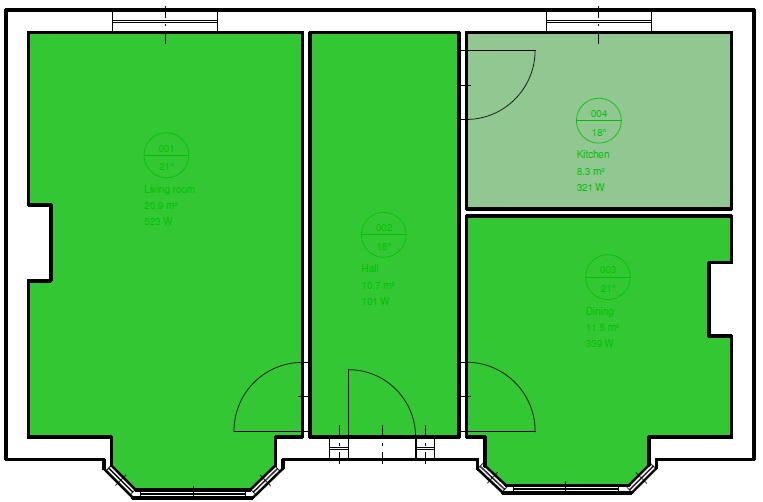
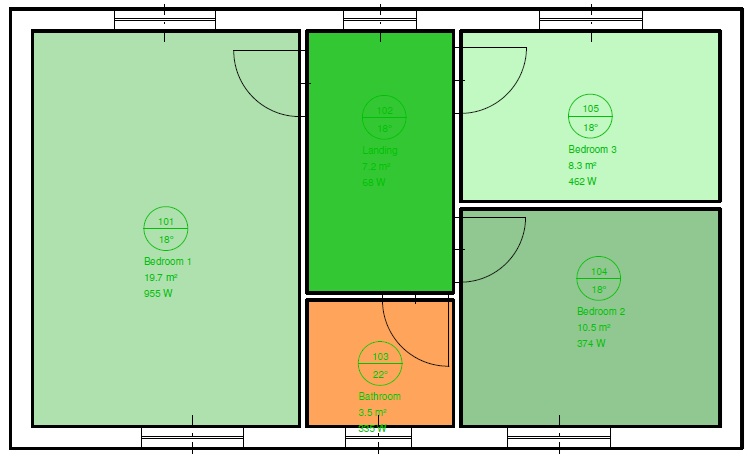
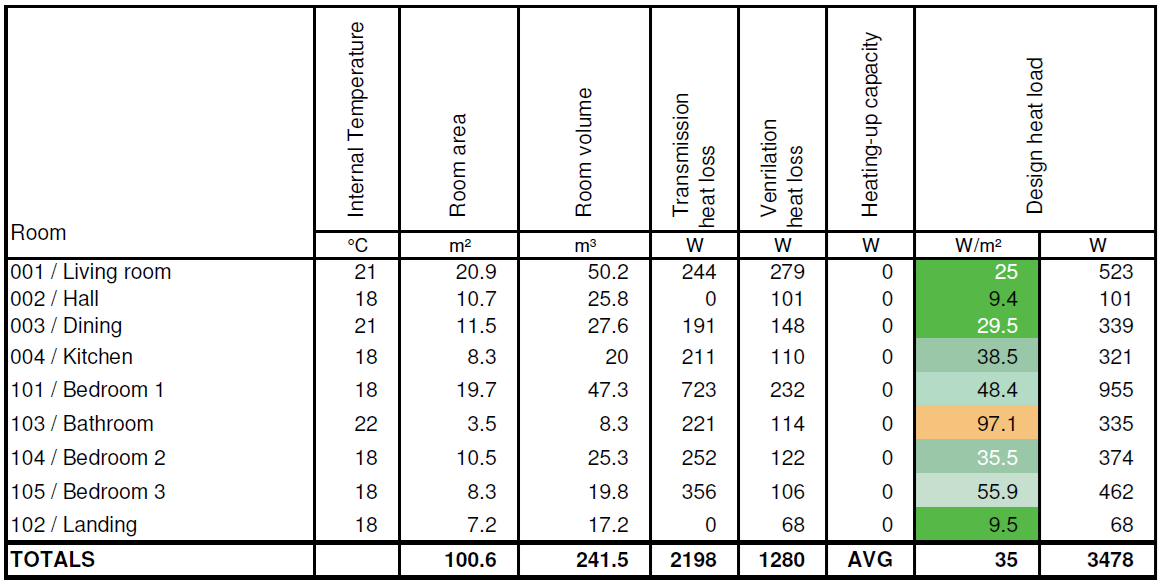
This model is rather typical of older housing stock that have been changed ownership recently with new owners upgrading the property
Lets drill down in to the data
around So immediately visible all rooms are performing significantly better than the previous versions, The improved insulation clearly helps, but also the improved airtightness of the building, significantly reduces the heat load.
We highly recommend home owners commission an air tightness test, as typically actual air tightness rates are better than assumed default values.
The result of these simple improvements is a reduction of around 44% in the total heat load compared with version 4 and around 75% reduction compared with version 1
With the introduction of reasonable insulation new double glazing the hand a reduction in the building air permiability the heat load for the building has reduced to 3.5 kW
How we can help
Whilst all insulation improvements will reduce the heat your building requires ( and potentially reduce your running costs ) Some forms of insulation are more cost effective than others, and quite often as you move more and more to higher specification (better performing insultion) the capital costs versus running costs savings can reduce (diminishing returns).
It should also be noted that not all forms of insulation are suitable for all buildings. For example spray foam roof insulation can lead to problems with mortgage lenders.
(The Royal Institution of Chartered Surveyors (RICS) have produced an impartial and comprehensive guide written by subject matter experts to update consumers on the latest guidance about the use of spray foam as a method of insulating residential properties.
(https://www.rics.org/news-insights/rics-release-new-spray-foam-consumer-guide)
If you commission us to prepare a heat loss calculation for you, we can then ammend the model for you to show you the impact of various different types and levels of insulation. Thus enebling you to make an informed decission as to which improvements work best for you.